

Table of contents

TL;DR
We developed a pre-IPO biotech investor presentation that brought scattered scientific, clinical, and company materials into one 25-slide story. Four connected chapters guided the presentation, supported by custom scientific illustrations, consistent clinical charts, and a coordinated visual system. The result was a deck designed for investor meetings and follow-up reading.

We developed a pre-IPO biotech investor presentation that brought scattered scientific, clinical, and company materials into one 25-slide story. Four connected chapters guided the presentation, supported by custom scientific illustrations, consistent clinical charts, and a coordinated visual system. The result was a deck designed for investor meetings and follow-up reading.
Amélie Laurent
Product Manager, Sisyphus

Years of R&D and clinical development had brought this clinical-stage biotech to its pre-IPO investor conversations. Now, that work needed to come together in 25 investor slides.
When the company came to us, the material was spread across previous decks, study reports, scientific references, and working slides. There was plenty to work with. What needed attention was the connection between those pieces.
That is where we started: what did investors need to understand first, and what would give the next slide meaning?
Across 700+ presentations we have built, we understand how much the order of information matters. For this pre-IPO biotech investor presentation, our job was to bring the science, clinical evidence, market opportunity, and company plans into one connected narrative.
Here’s how we approached the sequence, the scientific visuals, and the clinical data, and what other teams can take from those decisions.
Establish the Investment Thesis Before the Scientific Detail
Our first sequencing decision was to give investors an overview of the investment case before asking them to examine the biology.
In this project, the opening slides did that work in two steps: an investment-thesis slide connecting the treatment gap through to timing, followed by a company-at-a-glance slide introducing the lead asset, clinical progress, financing stage, and anticipated IPO timeline. Both sit within The Need, the first chapter of the pre-IPO company overview.
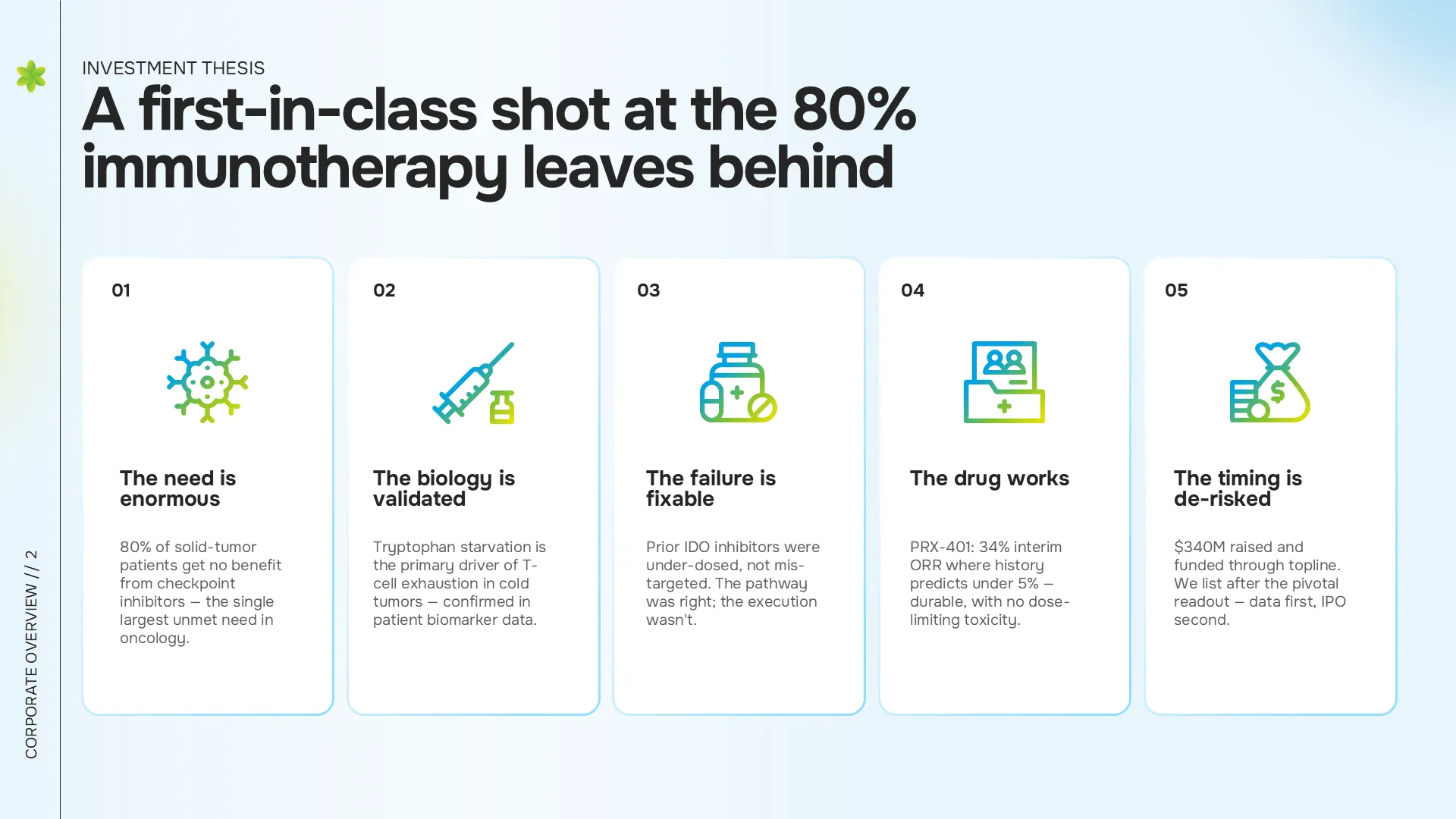
That opening gives the detailed slides a specific job: support the case the investor has just been introduced to. The mechanism explains the rationale; the clinical results provide evidence to assess it.
From there, we moved into the treatment limitations and patient population that made the opportunity worth examining.
How We Organized a 25-Slide Pre-IPO Biotech Presentation
Twenty-five slides, four chapters, one rule: sequence the deck the way a pre-IPO investor builds conviction. Problem, approach, proof, plan. Each chapter earns the next one a hearing, which is the difference between a pre-IPO biotech investor presentation and a stack of well-designed slides.
Chapter 1: The need
Those treatment limitations came first for a reason. The client’s framing was blunt: roughly 80 percent of patients with cold tumors respond poorly to existing immunotherapy. No molecule yet, no mechanism, no charts. Just the size of the gap, made undeniable, because every claim in the next 20 slides borrows its urgency from this one.
Chapter 2: The science
Then the biology: root cause, mechanism, and the lead molecule, PRX-401. This is the chapter where most biotech decks lose the room, and it is usually not the science’s fault. It is the textbook diagrams. We redrew everything as custom illustrations in the company’s own visual language, the same discipline we bring to every healthcare and biotech pitch deck we build. Dark slides carry these moments deliberately: they tell the room when to slow down and look.

Chapter 3: The evidence
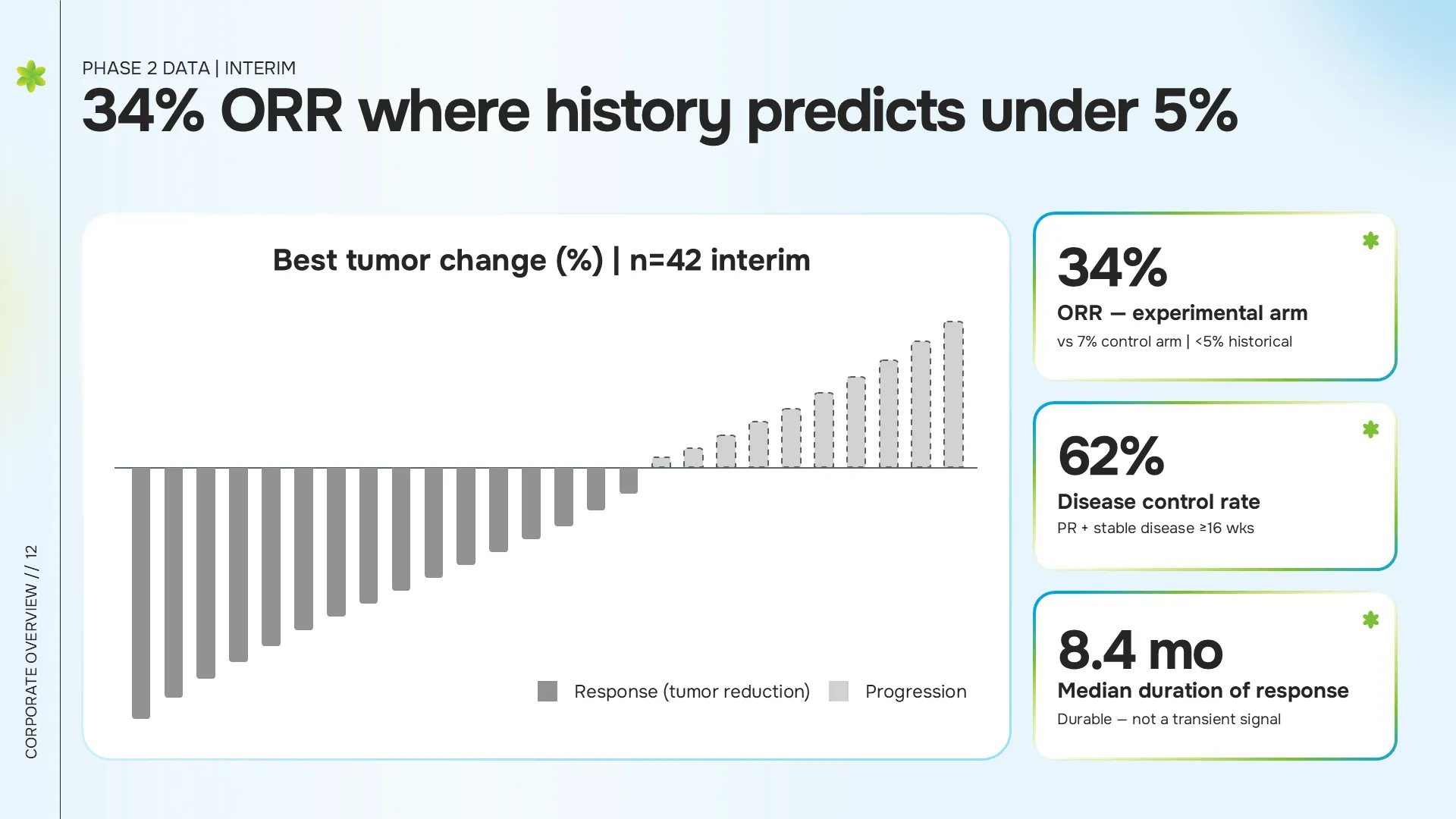
Study design, results, durability, safety. Then, and only then, the market. A market slide in a clinical-stage biotech deck is only as credible as the data slide before it, so we made the data easy to interrogate: every chart rebuilt in one visual system, every slide carrying a single stated takeaway. The investor reads the conclusion first and challenges the detail second, which is the reading order you want.
Chapter 4: The path
The closing chapter answers the question the whole room has been holding: what happens next, and when? Moat, partners, team, and the catalysts between here and the public markets, in order, with the value-changing events made explicit. Pre-IPO investors underwrite a timeline as much as a technology. The deck ends where their decision actually lives.
Keep the Story in the Main Deck and the Detail in the Appendix
The main deck carries the argument: need, science, evidence, path. The appendix carries everything an investor might ask about but should not have to read through. A pre-IPO deck works two shifts, presented live in the room and forwarded to people who were never there, and the appendix is what lets the main deck stay lean enough to survive both.
The test: can an investor who missed the meeting read the leave-behind and still follow the argument from unmet need to IPO catalyst?
Would your deck survive the pre-IPO read?
Answer honestly. Five questions, thirty seconds.