

Table of contents

TL;DR
A strong healthcare pitch deck does more than explain the science. It helps investors understand the clinical problem, product workflow, market opportunity, business model, and adoption path without getting lost. For healthcare AI founders, the real challenge is turning complex science and technical proof into a clear investor story.

A strong healthcare pitch deck does more than explain the science. It helps investors understand the clinical problem, product workflow, market opportunity, business model, and adoption path without getting lost. For healthcare AI founders, the real challenge is turning complex science and technical proof into a clear investor story.
Amélie Laurent
Product Manager, Sisyphus

A healthcare AI pitch deck carries more pressure than a typical startup deck.
In most SaaS decks, investors are looking at the product, market, growth, retention, GTM motion, and revenue model. Those still matter in healthcare.
Investors still care about the fundamentals: product, market, growth, GTM, revenue model, and team. But healthcare AI decks carry another layer of scrutiny: clinical relevance, regulatory path, workflow fit, patient safety, provider adoption, reimbursement logic, evidence quality, and commercial scalability.
The deck should make the science easier to evaluate, the product easier to picture, and the business case easier to trust.
The category is getting more attention. U.S. digital health startups raised $6.4 billion in the first half of 2025, with 62% of that funding going to AI-enabled firms
Investor interest is strong. But the category is crowded. “AI in healthcare” is no longer a differentiated story.
At the same time, healthcare AI is being evaluated with more discipline. Regulators and health systems are paying closer attention to patient safety, software performance, adverse events, and algorithm-related risk in AI-enabled medical devices. That changes how the deck needs to work. It cannot simply describe the product. It has to help investors evaluate the opportunity with clarity.
That context changes how the pitch deck should be built.
In this article, we will break down how to design a healthcare AI pitch deck for Series A investors, using our work with Cerevia Neurosciences as a case study.
A healthcare AI pitch deck should explain the clinical problem, product, proof, market, adoption path, business model, team, milestones, and fundraising ask. At Series A, the deck also needs to show how the company can move from technical credibility to commercial execution.
What Series A investors need from a healthcare pitch deck
Series A investors are looking for a clear bridge between technical promise and business execution.
At seed stage, a founder can often raise on vision, early proof, and a strong founding team. By Series A, the expectations are different. The deck needs to show that the company has moved beyond an interesting concept and is building toward a credible business.
A strong healthcare pitch deck should help investors understand:
For healthcare AI founders, the key is not to include every possible detail. The key is to show the right level of detail in the right order. The deck should help investors move through the story without constant explanation.
The strongest Series A decks follow this sequence.
Case Example: Cerevia Neurosciences Series A deck
We worked on a Series A pitch deck for Cerevia Neurosciences, an AI-driven dementia care platform.
Cerevia’s story sat at the intersection of dementia care, neurotechnology, AI-enabled personalization, mobile care delivery, and clinical evidence. The company had real depth, but that depth needed to be translated into a clearer investor narrative.
The original deck had strong scientific content. But like many healthcare AI decks, the structure and design created too much friction for the reader.
The main issue was whether an investor could quickly understand:
- What problem is Cerevia solving?
- Why does this matter in dementia care?
- How does the platform work?
- Where does the product fit into the patient or provider journey?
- What proof supports the approach?
- How does this become a scalable company?
The role of the pitch deck is to bring order to the complexity. It should help investors move through the problem, product, proof, and business case with enough clarity that the opportunity becomes easier to evaluate.
Lesson 1: Start with the clinical problem
Many healthcare founders naturally want to start with the invention.
That makes sense. Technology is where the years of work live. The science, patents, platform, mechanism, device, model, or AI system often represents the founder’s deepest advantage.
But investors want to start with a problem.

- Led with one clear message at the top,
- Used visual hierarchy to make the biggest numbers easy to scan
- Structured the slide to help the investor move through the logic quickly:
Clinical urgency → care gap → scale of impact → need for a better solution
If the investor understands the problem clearly, the product has a stronger foundation.
Lesson 2: Make the product feel real
Healthcare AI products can feel abstract.
That is especially true when the deck relies only on technical diagrams, backend workflows, scientific language, early renders, or dense product descriptions. All of that may be accurate, but it does not always help an investor understand the product in the real world.
That is the design challenge.
A healthcare pitch deck has to make the product tangible. It should answer four questions:
- What is the product?
- Who uses it?
- Where does it fit in the care setting?
- What makes the technology different?
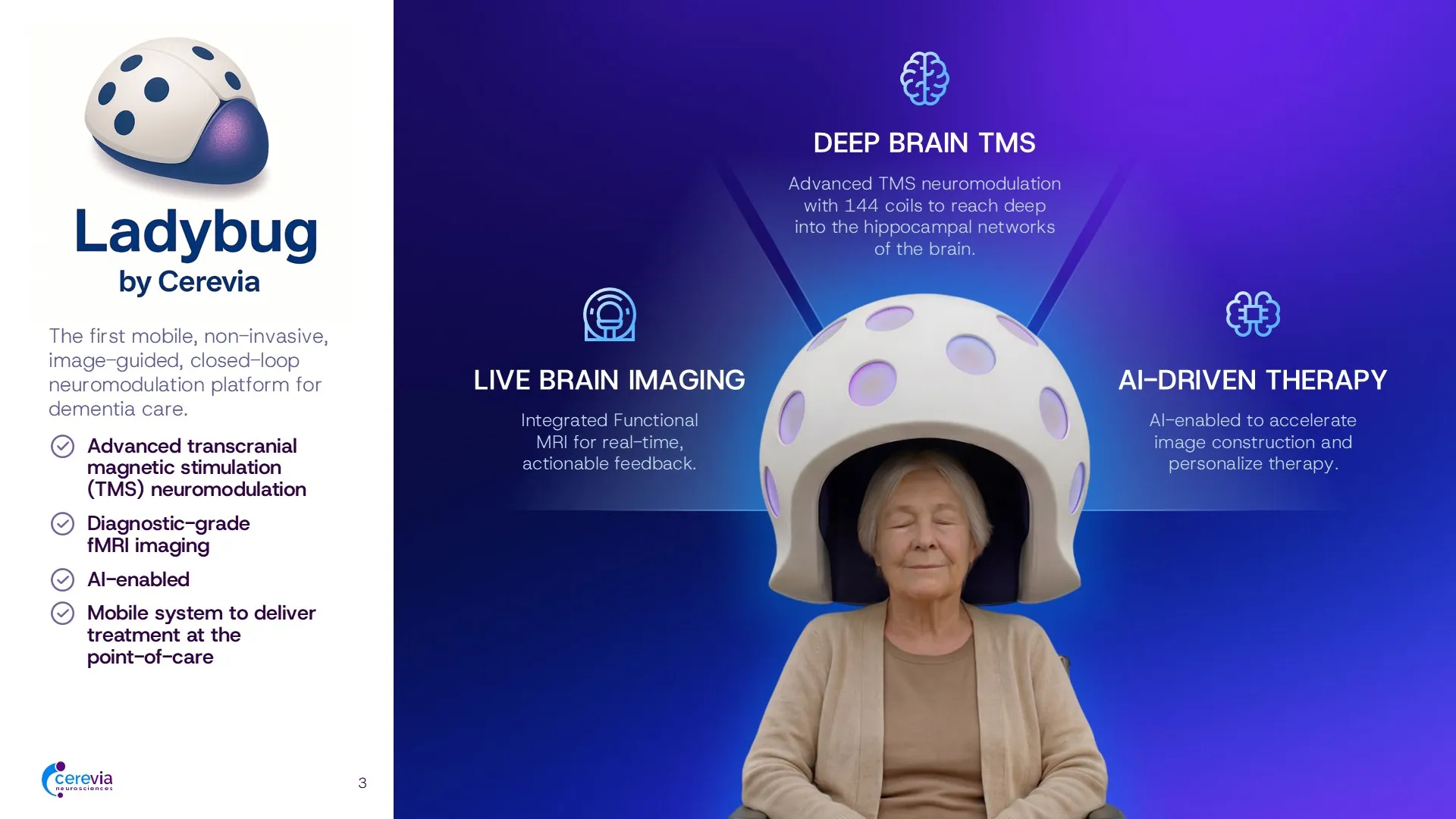
- The visual makes the product easier to understand in seconds.
- Slide uses 3 supporting callouts to explain the core technology behind the experience: deep brain TMS, live brain imaging, and AI-driven therapy.
When a product is visualized clearly, the founder does not have to spend the next five minutes helping investors imagine how it works.
Lesson 3: Simplify the science without weakening credibility
Healthcare founders often hesitate to simplify their pitch deck because they worry the science will feel less serious. That is usually the wrong concern.
The bigger risk is not that the science is too simple. The bigger risk is that the science is not organized in a way investors can evaluate.
A strong healthcare pitch deck organizes complexity into layers:
This is especially important for biotech and medtech pitch decks.
Investors want to know that the science is strong. But they do not want the main narrative to read like a clinical paper or technical appendix.
The main deck creates clarity.
The appendix protects depth.
Together, they build credibility.
This is where presentation design becomes more than aesthetics. The design system helps decide what investors see first, what they understand next, and what they can explore later.
Lesson 4: Design data heavy slides for scanning
Healthcare decks carry a lot of important data: clinical outcomes, patient populations, market sizing, regulatory milestones, financial projections, competitive comparisons, product performance, and care delivery economics.
Investors need to scan the slide, find the takeaway, and understand why the data matters. If they have to study the slide for too long, the point gets weaker.
Every data slide should answer 4 questions:
- What changed?
- What matters?
- What should the investor remember?
- Why does this support the investment case?
A clinical data slide should not simply show results. It should explain what those results mean for credibility, differentiation, or patient impact.

A financial slide should connect projections to hiring, milestones, product development, regulatory progress, sales motion, or market expansion.
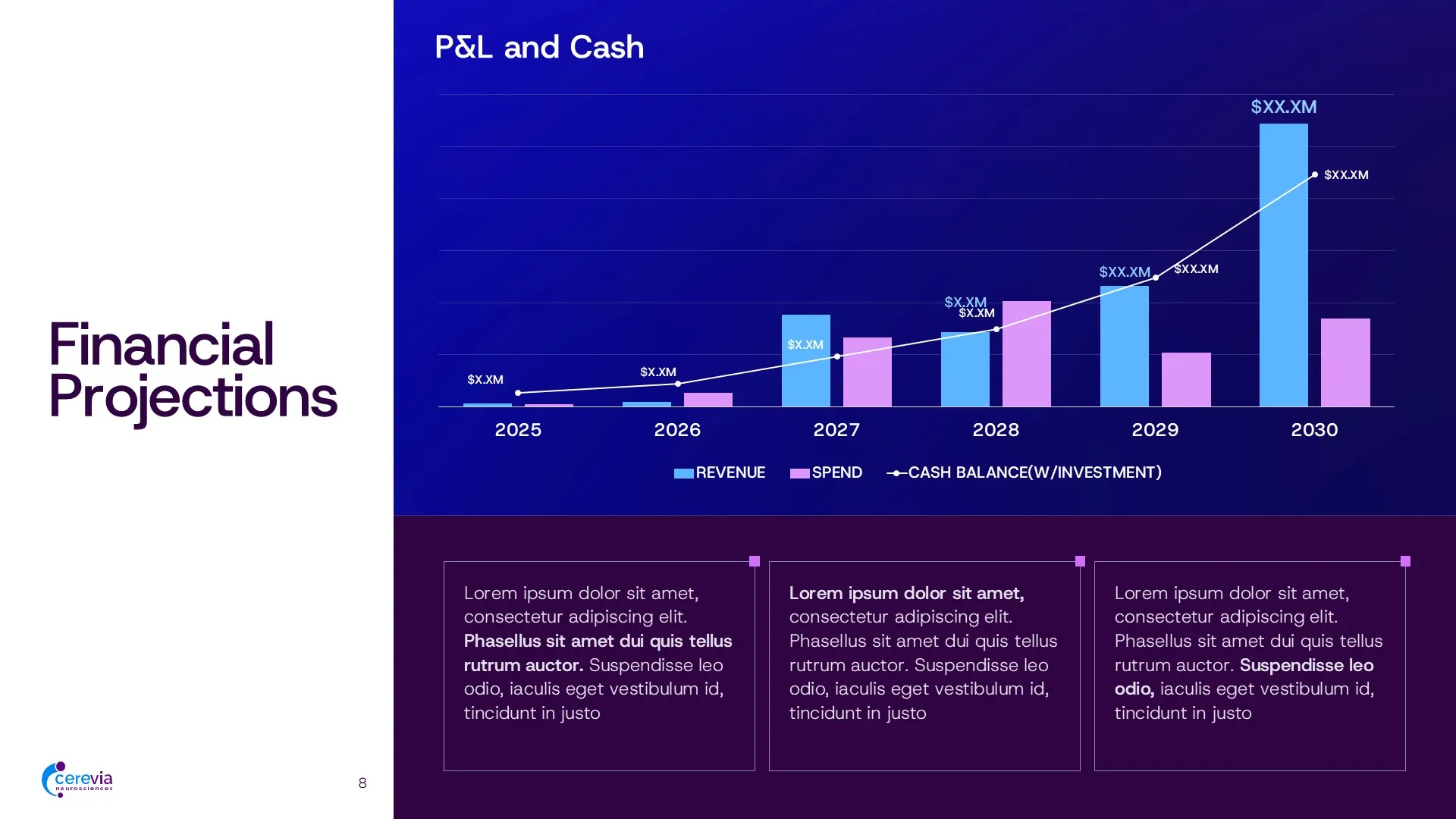
A market slide should show which part of the market the company can reasonably enter first.

This is where visual hierarchy matters:
- Slide title should carry the main insight
- Chart should support it
- Key numbers should stand out
- Supporting text should explain, not repeat.
A good investor deck should reduce the amount of explanation
Lesson 5: Make the deck feel credible before it feels creative
Healthcare pitch decks do not need to look flashy, but credible and easier to trust. Investors are evaluating clinical risk, technical depth, regulatory complexity, adoption friction, and commercial potential.
If the deck feels too loud, inconsistent, or generic, it weakens the signal.
The design language should match that - feel clear, disciplined, clinically aware, investor-ready, and easy to scan.
- Typography should feel intentional
- Spacing should make dense content easier to process
- Charts should be readable at a glance
- Colors should guide attention instead of competing for it
- Product visuals should feel specific to the company, not like generic healthcare imagery added at the end.
At M’idea Hub, we have worked with 200+ healthcare startups across biotech, medtech, life sciences, and health tech through our healthcare pitch deck design work. That experience matters because healthcare decks require more than visual polish. They require structure, hierarchy, restraint, and judgment.
Recommended healthcare AI pitch deck structure
There is no single perfect pitch deck structure for every healthcare company.
A biotech company in preclinical development will need a different emphasis than a medtech company preparing for commercialization. A diagnostics company will need a different proof structure than an AI workflow automation platform. A dementia care platform will need a different visual approach than a therapeutics company.
Still, most healthcare AI Series A decks need a version of this structure:
The exact order can change, but the logic should not.
The structure should follow the investor’s decision path - problem to solution to proof to market to execution.
If the product is highly technical, the deck may need an earlier “how it works” section.
If the company already has strong clinical data, proof may come earlier.
If the company is entering a complex care pathway, workflow visuals may need more space.
You can also view examples of how we approach investor-facing decks in our presentation design portfolio.
A healthcare AI pitch deck should build investor confidence
At Series A, investors are evaluating the science, the product, the market, the team, the adoption path, the financial plan, and the next layer of risk. If the deck cannot organize those pieces clearly, the opportunity becomes harder to trust.
That is why structure matters as much as design. The deck has to make the science understandable, the product credible, the market specific, and the business case easy to discuss.
That is what made Cerevia Neurosciences a strong example. The work was not simply about improving the slides. It was about turning a dense clinical and technical story into a sharper investor narrative.
Preparing for a Series A raise in AI healthcare? M’idea Hub helps technical teams turn complex science, product thinking, and clinical proof into investor-ready presentations.
Book a discovery call to review your deck and discuss next steps. →
Frequently Asked Questions
How much scientific detail should go into a healthcare pitch deck?
The main deck should include only the scientific detail needed to support the investment case. Deeper methodology, study design, technical proof, and supporting research should move into the appendix so the main narrative stays clear.
What is the biggest mistake healthcare founders make in investor decks?
The biggest mistake is assuming investors will connect the dots on their own. Strong healthcare decks do not just present information. They guide investors from clinical need to product value to market opportunity to execution plan.
How is a Series A healthcare pitch deck different from a seed-stage deck?
A seed deck can lean more on vision, early proof, and founder insight. A Series A deck needs stronger evidence, clearer milestones, a more developed go-to-market plan, and a sharper explanation of how the company becomes commercially scalable.
Should a healthcare startup hire a pitch deck design agency?
A healthcare startup should consider hiring a pitch deck design agency when the science is strong but the story, structure, or visuals are hard to follow. The right partner can help organize complex clinical, technical, and commercial information into a clearer investor-ready presentation.
.webp)