

Table of contents

TL;DR
Annual general meeting presentations often come together under intense time pressure. Financial data updates late, stakeholders add last-minute edits, and the deck grows quickly. This guide explains how fund managers and IR teams can structure an AGM presentation quickly while keeping the narrative clear, credible, and investor-focused.

Annual general meeting presentations often come together under intense time pressure. Financial data updates late, stakeholders add last-minute edits, and the deck grows quickly. This guide explains how fund managers and IR teams can structure an AGM presentation quickly while keeping the narrative clear, credible, and investor-focused.
Amélie Laurent
Product Manager, Sisyphus

 ChatGPT
 Google AI
 Claude
 Perplexity
A few weeks before an annual general meeting, a familiar situation begins to unfold inside many private equity and venture capital firms.
Investor relations teams start assembling slides. Finance teams finalize performance numbers. Portfolio updates arrive from operating partners. Senior partners review messaging and strategic positioning.
Meanwhile, AGM presentation, a single document that will communicate the fund’s performance and strategy to investors, is still evolving.
What often begins as a concise investor update gradually expands into a 70-slide presentation filled with tables, text, and late edits.
At some point in the process, the same question inevitably surfaces.
"Can we make this easier for investors to understand?"
This challenge is common because AGM presentations sit at the intersection of complex information and tight deadlines. Portfolio metrics, valuation updates, exits, and market commentary all need to come together into a single narrative — often while the underlying numbers are still being finalized.
Under these conditions, clarity can easily suffer.
Slides become crowded with numbers. Key insights get buried inside dense financial tables. Investors find themselves scanning through pages of data just to understand the bigger story behind the fund’s performance.
Yet the purpose of an AGM presentation is not simply to report information.
It is to help investors quickly understand how the fund created value, how the portfolio evolved, and where the strategy is heading next.
In this article, we’ll explore how fund managers and investor relations teams can prepare a high-impact annual general meeting presentation even when timelines are tight. We’ll look at the structure, slides, and design principles that help investors quickly see what matters most with the help of a case study.
Where AGM Presentations Typically Go Wrong
Even with weeks of preparation, many AGM presentations often become difficult for investors to navigate.
The issue usually isn’t a lack of effort. In fact, AGM decks are often the result of weeks of preparation across multiple teams. The challenge lies in how information accumulates during the process.
By the time the presentation reaches its final form, the original narrative can become diluted.
Here are 4 patterns that we often see:
The Fastest Way to Structure an AGM Presentation
When preparation timelines are tight, the biggest mistake teams make is starting directly in PowerPoint.
Slides are created before the narrative is clear. Metrics are added before the story behind them is defined. As revisions accumulate, the presentation becomes harder to follow.
A better approach is to start with a clear structural framework.
The most effective AGM presentations follow a simple sequence that mirrors how investors evaluate a fund: performance, portfolio progress, and forward strategy.
Below is a structure many funds use to prepare an AGM presentation quickly while keeping the narrative clear.
1. Start With the Strategic Narrative
Before designing slides, clarify the story the presentation needs to communicate.
Investors attending an annual general meeting are typically trying to understand a few core questions:
- What drove performance this year?
- How has the portfolio evolved?
- What strategic decisions shaped the fund’s results?
- What should investors expect going forward?
Answering these questions early helps prevent the presentation from becoming a collection of disconnected updates.
2. Use a Repeatable AGM Presentation Structure
A clear AGM presentation structure helps investors quickly navigate the deck.
Most effective AGM decks follow a sequence similar to this:
- Agenda and meeting overview
- Market context and macro environment
- Fund performance overview
- Portfolio highlights and key developments
- Exits and liquidity events
- Capital deployment and reserves
- Risk factors and market outlook
- Forward strategy and priorities
This structure mirrors the questions investors naturally ask during an AGM.
When the presentation follows this order, LPs can quickly connect data, decisions, and outcomes.
3. Prioritize the Slides Investors Care About Most
Not every piece of information needs to appear in the main presentation.
The most effective AGM decks focus on the slides that directly explain performance:
- fund performance metrics
- NAV progression
- portfolio growth
- exits and distributions
- capital deployment
Operational detail and supporting analysis can be moved to the appendix.
4. Move Supporting Data to the Appendix
One of the easiest ways to improve clarity is to separate primary narrative slides from supporting data.
The main deck should highlight insights.
The appendix can include:
- detailed financial tables
- portfolio operating metrics
- valuation methodology
- additional market analysis
This approach allows investors to understand the key story first while still having access to deeper information when needed.
When teams apply this structure, the preparation process becomes much more efficient.
The next step is understanding which slides matter most inside that structure.
Essential Slides Every AGM Presentation Should Include
Lessons From the Noven Group AGM Deck
The structure of an AGM presentation becomes much easier to understand when looking at a real example.
About Project
Noven Group, a private equity investment firm advancing life science innovation and human health. The firm partners with visionary companies developing breakthroughs in biotechnology, digital health, and therapeutic platforms.
When Noven Group approached us, their AGM presentation contained valuable information but lacked the clarity needed for an investor audience.
The deck had several challenges:
- Text-heavy slides
- Limited visual hierarchy
- Inconsistent branding
- Fragmented narrative flow
In other words, the presentation functioned more like an internal report than an investor-focused story
Timeline
1 Week
Approach
Rather than simply redesigning individual slides, the project began by restructuring the narrative.
The presentation was rebuilt around three core questions that investors typically ask during an AGM:
- How has the fund created value?
- How has the portfolio evolved?
- What strategic direction comes next?
Once the narrative structure was established, the slides were redesigned to emphasize clarity.
Below are 6 key slides that illustrate how the presentation evolved.
1. The Fund Snapshot Slide
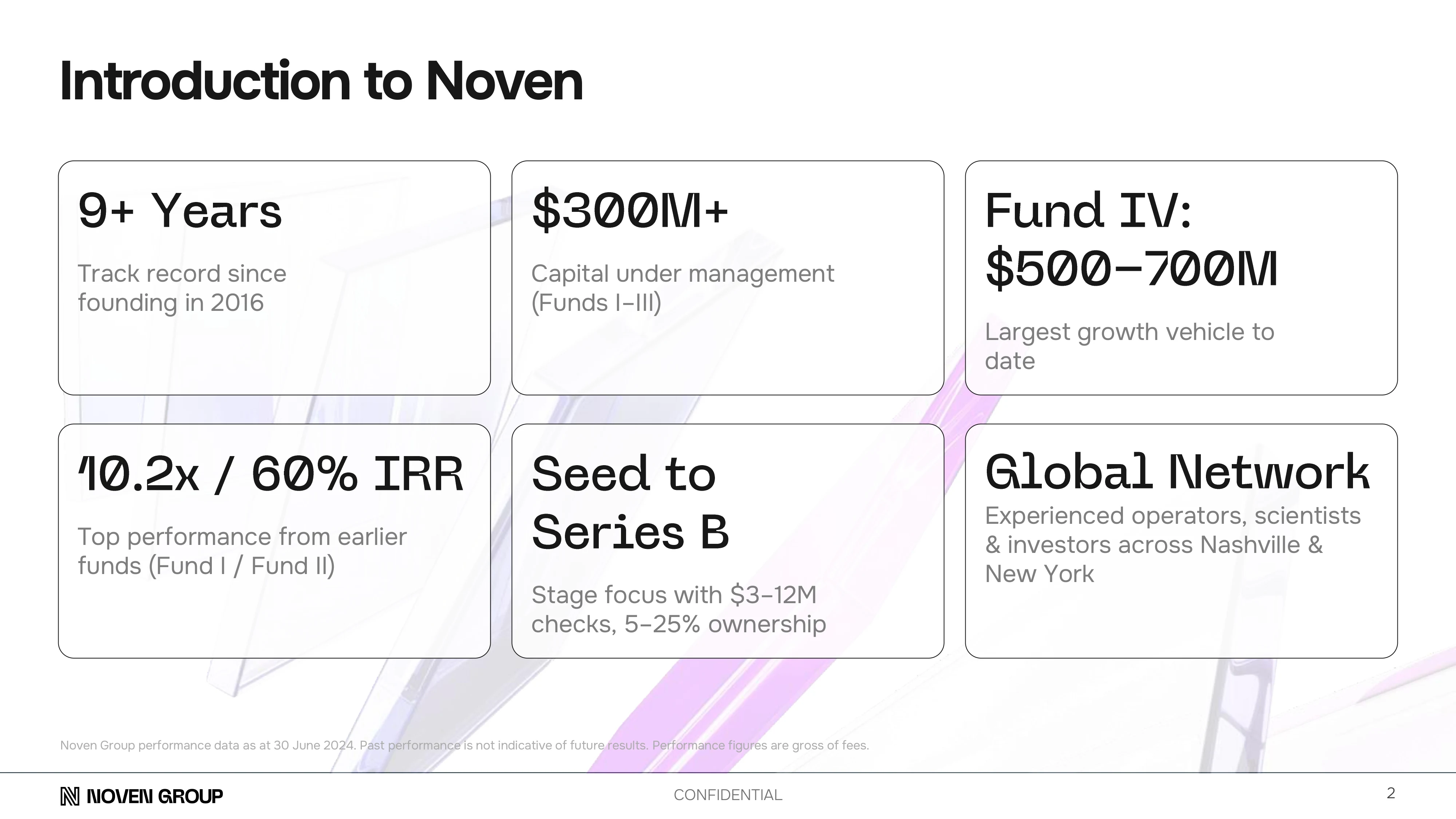
One of the most important slides in an AGM presentation is the fund snapshot.
This slide provides investors with a quick overview of the firm’s scale, track record, and positioning.
Key information typically includes:
- assets under management
- track record and fund performance
- investment stage focus
- geographic reach
The goal is simple: help investors understand the fund in under 10 seconds.
This slide acts as an anchor for the rest of the presentation.
2. The Investment Strategy Slide
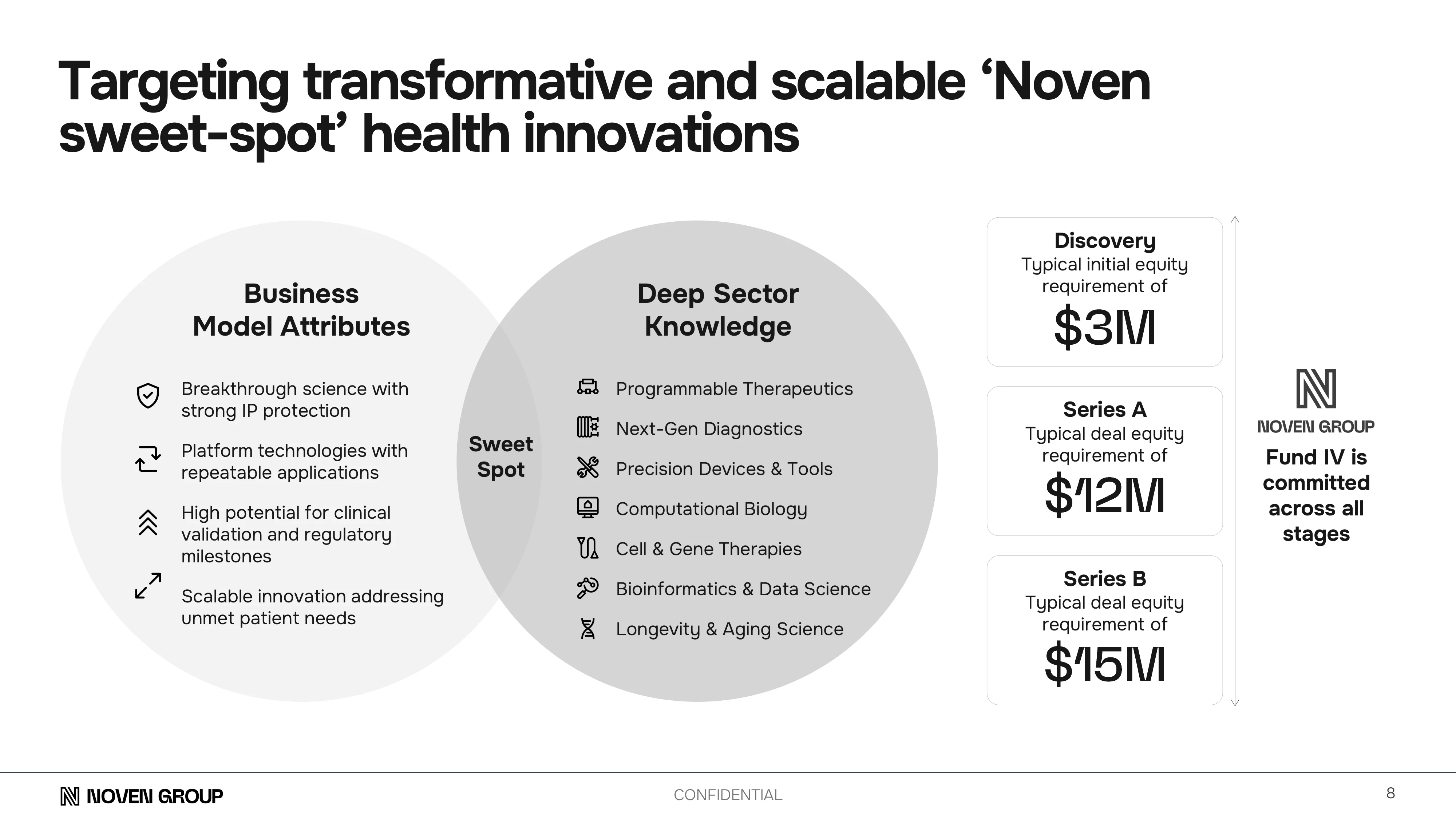
After the fund overview, the next critical slide explains how the fund creates value.
For Noven Group, the strategy slide clarified the firm’s focus on transformative health innovations.
The redesigned slide highlights two essential elements:
1. Business Model Attributes
2. Deep Sector Expertise
Instead of paragraphs of text, the slide uses visual grouping to make the strategy easy to understand.
3. The Performance and Value Creation Slide
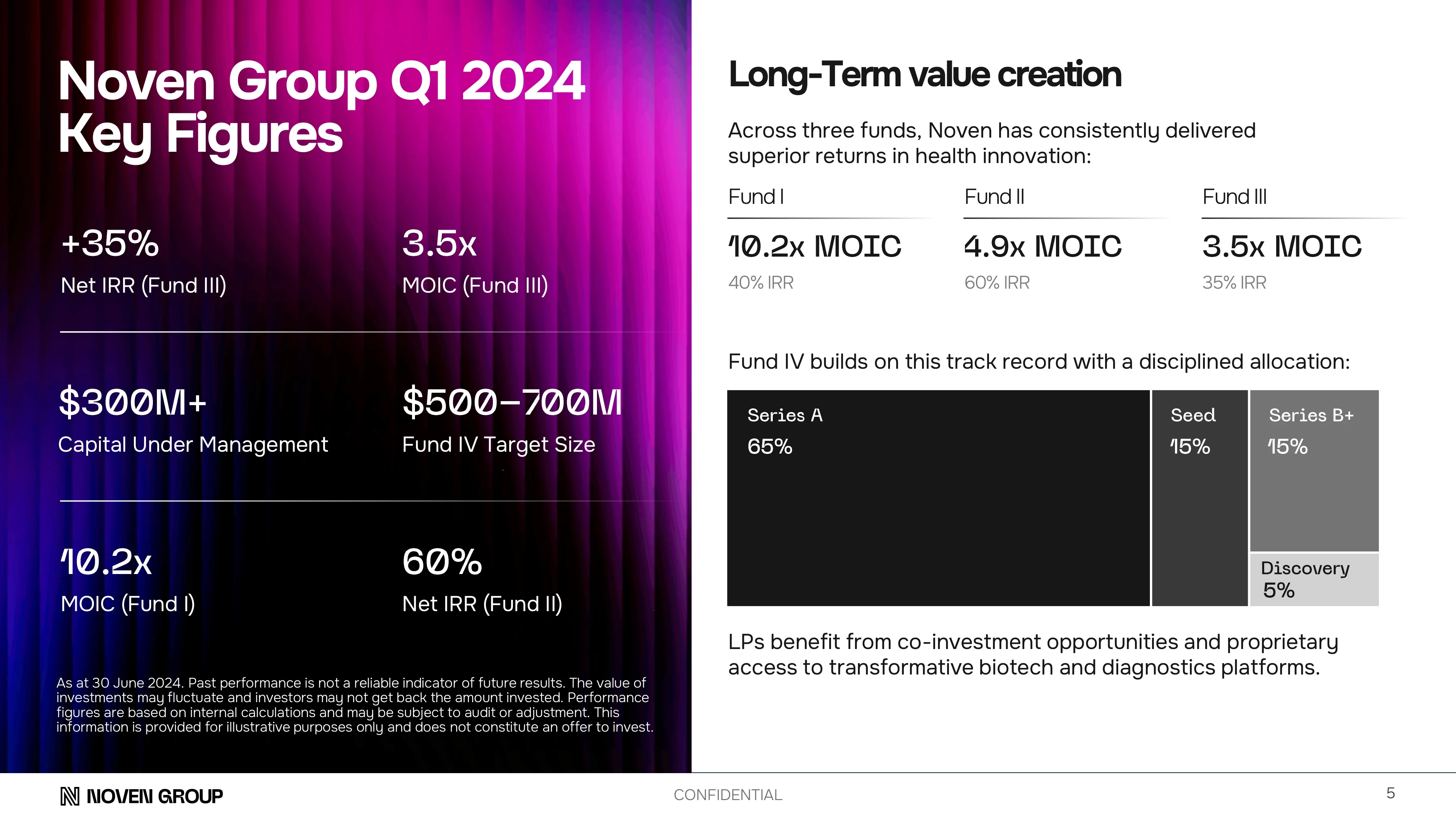
Perhaps the most important section of any AGM deck is the slide explaining performance.
For Noven Group, the redesigned presentation highlighted the firm’s long-term track record across multiple funds.
Key performance indicators included:
- Net IRR
- Multiple on invested capital (MOIC)
- capital under management
- fund size targets
By visualizing these metrics clearly, investors can quickly connect portfolio progress to financial outcomes.
4. The Market Opportunity Slide
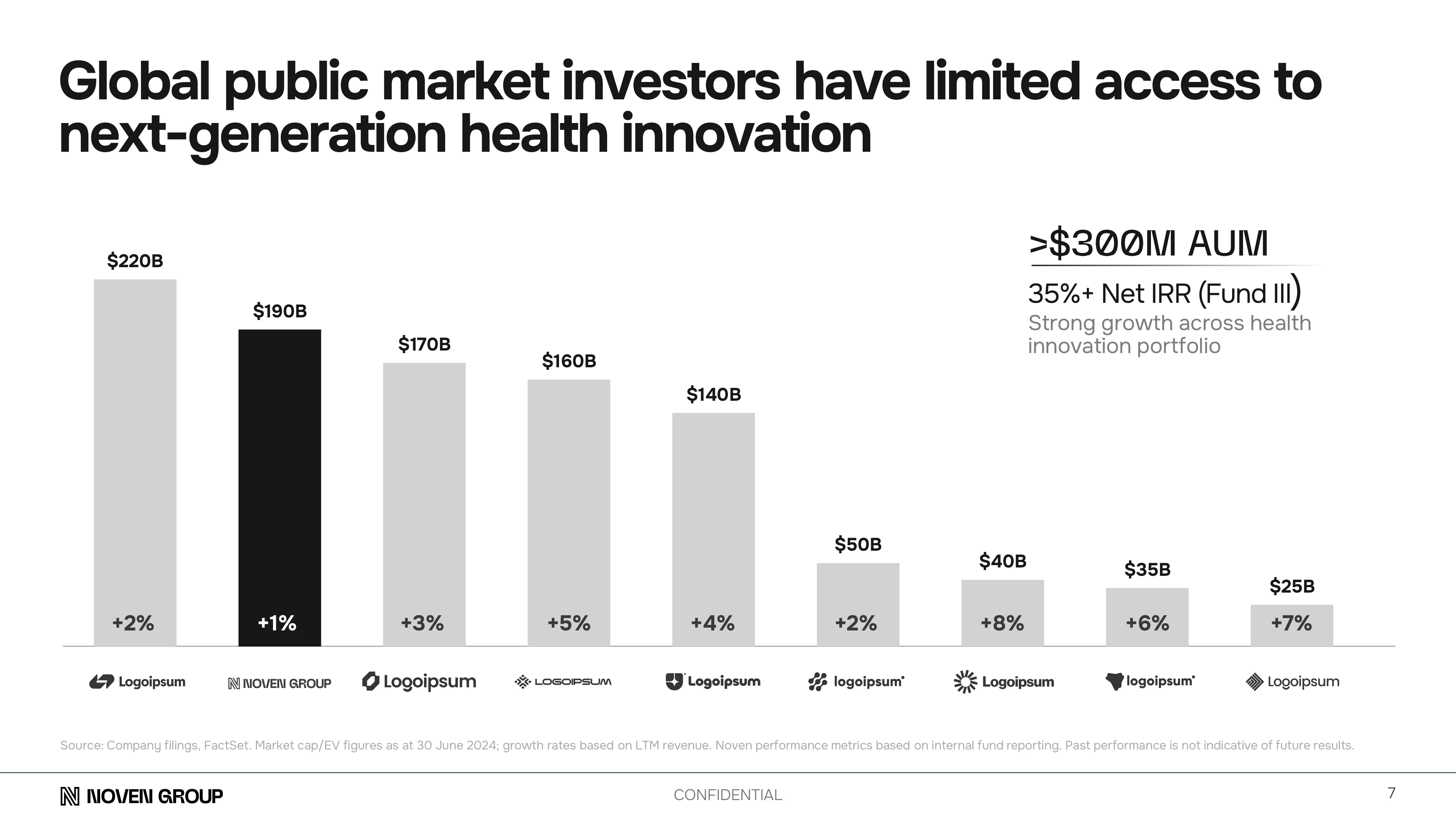
Strong AGM presentations also provide context about why the strategy matters.
In the Noven deck, one slide explained the broader opportunity in next-generation health innovation.
The slide compared:
- public market investment levels
- emerging biotech sectors
- innovation gaps within healthcare
This context helped investors understand why private capital plays a critical role in advancing health innovation.
5. The Portfolio Overview Slide
.png)
Investors attending an annual general meeting want to quickly understand how capital is deployed across the portfolio.
Instead of listing companies across multiple slides, the redesigned deck consolidates key investments into a structured portfolio overview.
The slide shows:
- leading portfolio companies
- sector focus
- geographic distribution
- capital allocation across investments
This allows investors to quickly identify where the fund’s capital is concentrated and which companies are driving value.
6. Portfolio Performance & Outlook
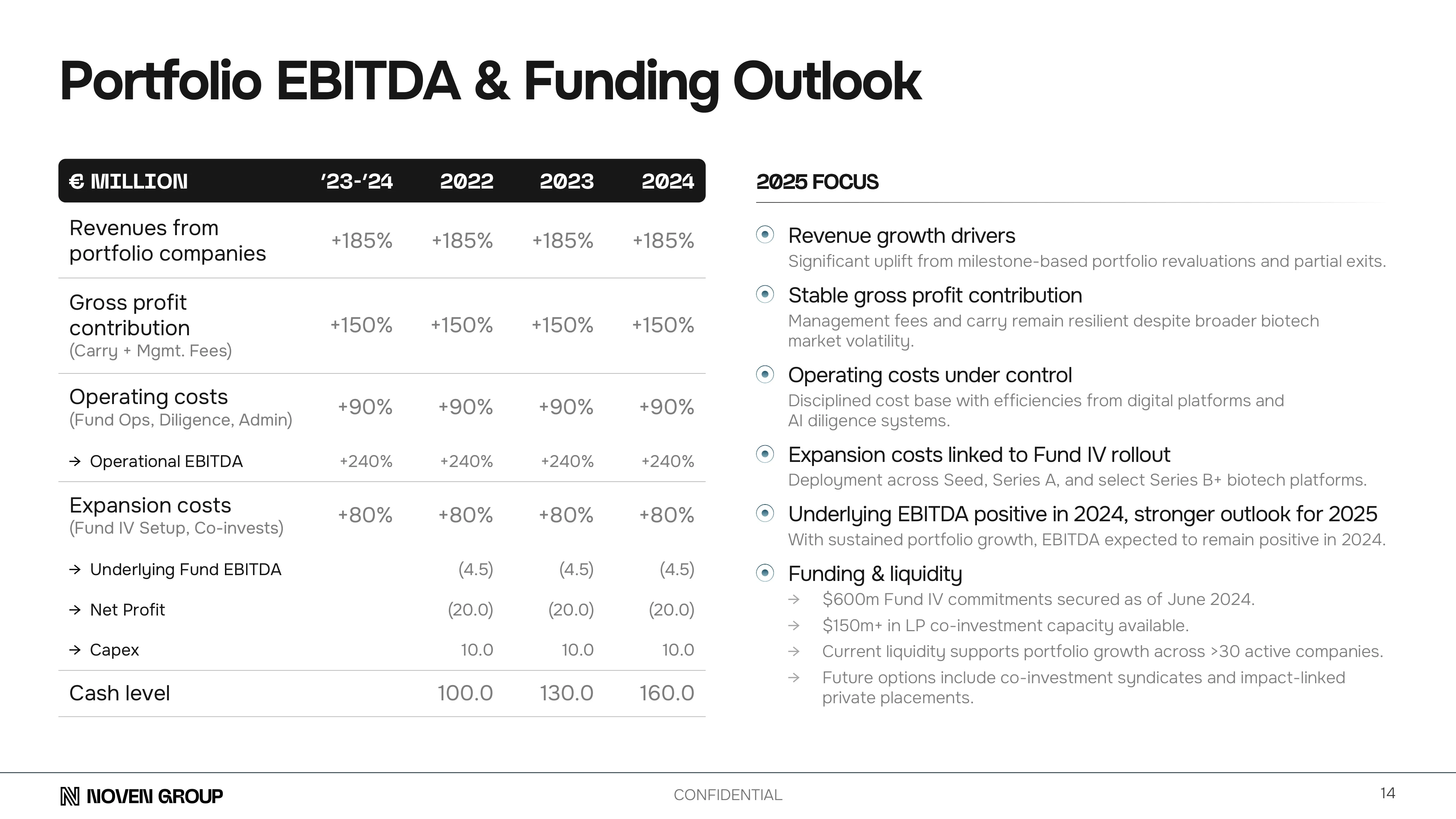
Finally, the presentation included slides explaining performance across the portfolio.
These slides summarized:
- revenue growth across portfolio companies
- operating profitability trends
- cost discipline
- forward funding outlook
Rather than overwhelming investors with raw financial tables, the redesigned slide organizes metrics into clear categories and highlights the key drivers of performance.
The Outcome
The redesigned AGM presentation delivered several immediate improvements:
- Clearer structure that guided investors through the narrative
- Data-driven storytelling connecting performance metrics to strategy
- Impactful charts replacing dense financial tables
- Forward-looking design emphasizing the fund’s strategic trajectory
Instead of functioning as a dense internal document, the presentation became a clear investor communication tool.
View full portfolio here: https://www.mideahub.com/portfolio-pages/noven-group
Design Principles That Make AGM Presentations Easier for Investors to Understand
Even when the right slides are included, an AGM presentation can still be difficult to interpret if the design does not support the narrative.
Private equity and venture capital presentations often contain dense financial information, portfolio metrics, and operational updates. When this information is not structured visually, investors must spend time deciphering slides instead of focusing on the message.
The most effective AGM presentations use design intentionally to guide investor attention.
Here are 5 design principles that consistently improve clarity.
Establish Clear Visual Hierarchy
Visual hierarchy determines what investors notice first when they look at a slide.
Strong hierarchy ensures that the most important insight stands out immediately.
This can be achieved by emphasizing:
- key performance metrics
- headline takeaways
- primary charts or visuals
Supporting information should appear secondary.
When hierarchy is clear, investors can quickly understand the slide’s message without reading every detail.
Simplify Data Into Visual Insights
Financial tables are common in AGM presentations, but raw data rarely communicates insights effectively.
Whenever possible, data should be translated into visuals such as:
- bar charts showing performance trends
- value bridges explaining NAV changes
- portfolio allocation diagrams
Well-designed charts allow investors to see patterns instantly, rather than calculating them mentally.
Use Consistent Slide Frameworks
Consistency across slides helps investors process information faster.
For example:
- portfolio slides follow the same layout
- performance metrics appear in consistent locations
- charts use the same visual style
This creates familiarity throughout the presentation, making it easier for LPs to follow the narrative.
Reduce Text and Focus on Key Messages
Text-heavy slides are one of the most common issues in AGM decks.
Long paragraphs force investors to read instead of listen during the presentation.
Effective slides typically:
- highlight one primary message
- use short supporting bullet points
- rely on visuals wherever possible
This approach keeps attention on the discussion and insights, rather than on reading dense text.
Move Supporting Detail to the Appendix
Many presentations become overloaded because teams try to include every piece of supporting data in the main deck.
A better approach is to move deeper analysis into the appendix.
The main presentation should highlight:
- key insights
- performance drivers
- strategic updates
The appendix can then contain:
- detailed financial tables
- valuation methodologies
- operational metrics
This keeps the narrative clear while ensuring supporting data is available when questions arise.
Need Help Preparing Your AGM Presentation?
AGM season often arrives quickly, and many teams find themselves preparing investor presentations under tight timelines.
If your team is working on an upcoming AGM deck and wants to ensure the narrative and design communicate clearly with LPs, we can help.
At M’idea Hub, we specialize in investor presentation design for private equity and venture capital, helping teams turn complex information into clear, compelling presentations.
Explore our portfolio of investor presentations or book a discovery call to discuss your upcoming AGM presentation.
Frequently Asked Questions