Table of contents

TL;DR
A well-designed VC fund pitch deck is important to winning over LPs and securing funding. This blog outlines the 15 key slides every fund deck should include. Clear storytelling, strong visuals, and concise messaging are critical to standing out.

A well-designed VC fund pitch deck is important to winning over LPs and securing funding. This blog outlines the 15 key slides every fund deck should include. Clear storytelling, strong visuals, and concise messaging are critical to standing out.
Amélie Laurent
Product Manager, Sisyphus

 ChatGPT
 Google AI
 Claude
 Perplexity
Just as startups need a pitch deck to attract investors, VCs need a fund deck to bring Limited Partners (LPs) on board.
But here’s the difference: while startup decks tell the story of a single company, VC fund pitch deck has a bigger challenge; it must convey the vision of your entire fund, your ability to identify high-potential opportunities, and your strategy to generate outsized returns.
As a General Partner, you know how competitive fundraising can be. LPs receive hundreds of fund decks annually to choose from, and if your fund deck doesn’t stand out, it risks getting lost in the shuffle.
That’s why a well-structured and visually compelling fund pitch deck is more than a nice-to-have. It's essential.
In this blog, we’ll walk you through the 15 essential slides that every winning fund pitch deck should include, along with expert insights and design tips to craft a deck that resonates with LPs.
This guide is built specifically for venture capital fund decks. If you're raising a private equity fund instead, the LP narrative and slide structure differ significantly. Read our private equity pitch deck guide for the PE-specific framework.
What is a fund deck, and why do you need one?
A fund deck is a presentation used by General Partners (GPs) to pitch their venture fund to potential Limited Partners (LPs), outlining the investment thesis, track record, and financial goals. Basically, the goal of a fund deck is to convince LPs that your fund is uniquely positioned to deliver strong returns.
But a great fund deck goes beyond informing—it persuades. LPs evaluate numerous opportunities every year, so your deck must stand out by demonstrating:
- Clarity: A concise and easy-to-follow structure.
- Credibility: Proof of your expertise, track record, and value proposition.
- Engagement: Visually appealing design and storytelling.
Studies show that the initial 30 seconds are crucial—fail to capture attention in that window, and you may lose the LP's interest entirely.
And this is why Design plays a vital role in a fund deck, as it impacts how LPs perceive the fund and the team behind it. It conveys professionalism, attention to detail, and a clear understanding of the market and target audience.
Clean typography, clear headings, and concise bullet points make your story easy to follow, while visuals like graphs and charts bring data to life.
Want inspiration? Check out our portfolio to see how expert design can elevate your pitch.
15 key slides to include in your venture fund pitch deck
Your fund pitch deck should tell a story and address LP priorities effectively. Below are the 15 essential slides every winning deck must include:
Slide 1: Cover slide
Your cover slide sets the tone for the entire fund deck and emphasize your branding. A well-designed cover slide leaves a lasting impression.
- Highlight your positioning as a deck title, which can then be followed throughout the VC fund pitch deck.
- Use high-resolution images that reflect your fund's focus.
- Incorporate your logo and brand colors consistently.

Slide 2: Disclosure
The disclosure slide ensures legal compliance and transparency. By stating that the deck is for informational purposes only, you establish credibility and professionalism upfront.
Remember, transparency builds trust, and this slide is your first step in that direction.
- Use a clean, uncluttered layout to present the text clearly.
- Ensure the font size is legible and professional, even for dense text.

Slide 3: Thesis and company overview
The slide should introduce the fund’s investment thesis, outlining its specific investment focus and goals. It should also include a brief overview of the company and its mission, providing a high-level understanding of what it does and aims to achieve.

Slide 4: Problem statement
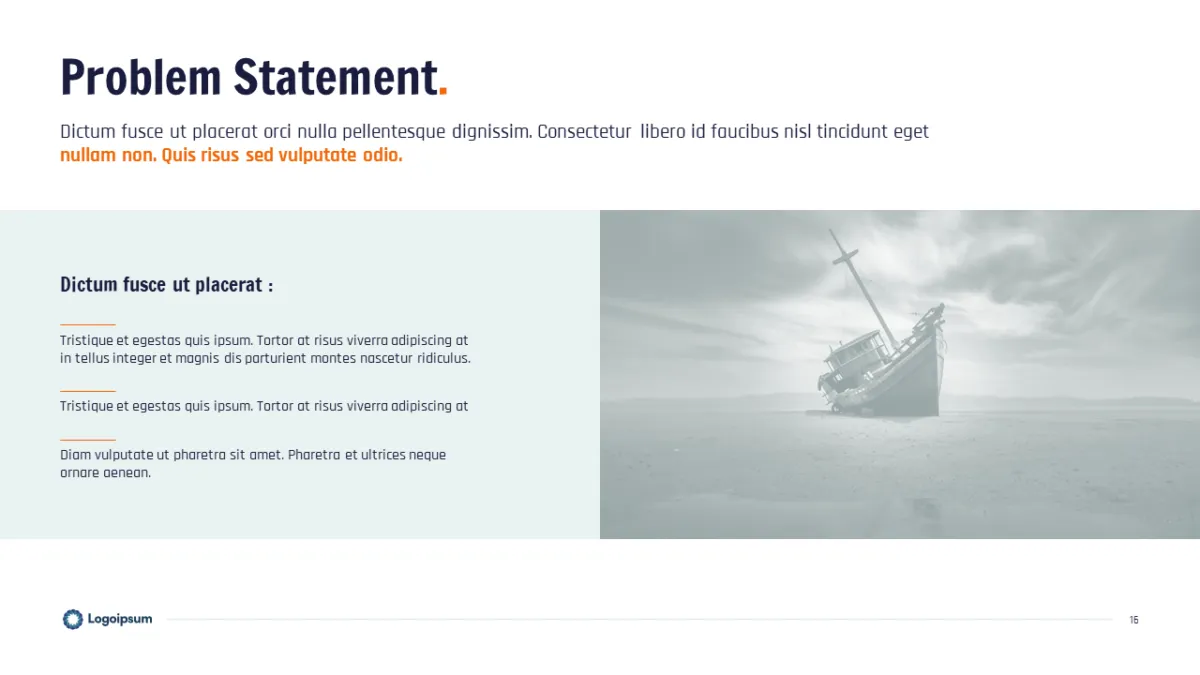
It should focus on the problem the fund seeks to address. The problem can be in the market, a challenge the industry faces, or a gap in the market that the company is looking to fill.
The slide should explain how this problem affects the industry and present the opportunity for investors to capitalize on this issue.
- Use bold text or color to emphasize key points
- Add visuals to relate to the problem statement
Slide 5: Ecosystem and solution
Explain how your fund fits into the broader industry ecosystem and how it addresses the identified problem. This slide connects the dots between the problem and your unique solution, making it clear why your fund is positioned to succeed.
- Use a flowchart or ecosystem map to illustrate relationships.
- Highlight your solution with bold text or standout colors.

Slide 6: Track record
This slide demonstrates your fund’s ability to deliver results. Highlight key metrics, such as IRR, MOIC, or successful portfolio exits, to showcase your expertise and build confidence with LPs.

Slide 7: Team
LPs invest in people first. Showcase your team’s expertise, synergy, and ability to execute your fund’s strategy. Include complementary skills and any notable achievements that make your team uniquely qualified.
- Use a clean layout to highlight team bios and experience metrics.
- Include logos or icons to represent past employers or portfolio successes.

Slide 8: Investment thesis
Summarize your fund’s investment thesis and explain your approach to investing. Include focus areas, such as target markets or sectors, and provide examples of companies you’ve invested in or plan to target.
This slide helps LPs understand your strategic lens.

Slide 9: Standout fund companies
This slide should compare the fund to other industry companies, highlighting how it stands out from its peers. This can include metrics or data demonstrating the fund’s superior performance or unique value proposition, showcasing the fund’s competitive advantage.
- Use side-by-side comparisons with bar charts or tables.
- Add company logos or visuals to highlight standout investments.
- Focus on 2–3 examples to keep the slide visually clean.

Slide 10: Acquisition engine
Explain your fund’s acquisition strategy and how you identify and build a portfolio of companies. This slide should highlight your process and the value it creates for both LPs and portfolio companies, aligning with details outlined in the use of funds slide.

This 'Standout Fund Companies' slide is a compelling addition to any vc fund pitch deck, showcasing key portfolio companies and their respective Series A funding rounds. Crafted by pitch deck experts, this section of the venture capital fund deck highlights significant investment highlights and the value created, demonstrating how a skilled pitch deck expert builds a convincing case for competitive advantage.
Slide 11: Focus areas
Highlight the areas where your fund will concentrate its investment activities. Explain why these focus areas are essential for success and how they align with your strategy. Use icons or small visuals to represent each focus area.

Slide 12: Fund strategy
Outline your fund’s investment strategy, including how you manage risks and target returns. This slide helps LPs understand how you’ll achieve your goals and measure success.
.webp)
Slide 13: Fund structure and performance
Provide an overview of your fund’s structure and performance. Include data on fund size, GP commitment, and risk management strategies to show how your structure supports your goals. Additionally, provide data on the fund’s current performance, including historical returns and assets under management.
Finally, compare the fund’s performance to industry benchmarks to show its competitiveness and potential for future success.
- Use tables to break down fund structure details.
- Include comparative performance charts to benchmark success.
- Highlight critical metrics with bold text or callout boxes.

Slide 14: From our founders
Share testimonials from founders you’ve worked with to demonstrate the real-world impact of your investments. These quotes build credibility and provide insight into the value your fund brings to portfolio companies.
- Use founder headshots and their company logos alongside testimonials for a personal touch.
- Align visuals with your brand to maintain consistency.

Slide 15: Portfolio case study
Provide a detailed case study of a successful investment. Highlight how you identified the opportunity, supported the company, and delivered results.
This slide serves as tangible proof of your fund’s ability to create value. Display crucial financial metrics, such as the amount invested, current equity value, and unrealized gains, to give LPs a quick snapshot of portfolio performance.
- Use a clean layout
- Use the portfolio company logo and a relevant testimonial for credibility.

Checklist for a winning VC fund deck
Here is a checklist for designing a well-structured and polished fund deck:
- Capture attention quickly because the first 30 seconds matter most.
- Use a clean and professional layout to convey a sense of credibility and expertise.
- Keep the VC pitch deck concise and to the point
- Ensure easy navigation and the flow of information
- Highlight the key information
- Very important: highlight your team’s expertise as LPs invest in people first.
- Use clean, professional design because good visuals make your story memorable.
- End with a strong CTA to guide VCs to take the next step.
Bringing it all together
A winning VC fund deck is your key to raising capital and building trust with LPs. By focusing on storytelling, design, and LP priorities, you can craft a deck that stands out in a competitive market.
Download the Venture Capital Fund Pitch Deck Template to bring your story to life with a clear, LP-ready structure.
At M’idea Hub, we are trusted presentation design partners for 25+ VCs. With domain expertise in designing fund decks, our team understands what it takes to translate your vision into a visually stunning and structured pitch that resonates with LPs.
Raising a private equity fund instead? Read our PE fund pitch deck guide - the structure and LP narrative are tailored differently.
So, why wait? Contact us today or book a discovery call now!
FAQs
1. What is a VC fund pitch deck?
A VC fund pitch deck is a presentation used by fund managers to communicate their investment thesis, strategy, track record, and differentiation to limited partners. Unlike startup pitch decks, fund decks focus more on process, judgment, and repeatability rather than a single product or market.
2. Why does a VC fund pitch deck need a different structure than a startup deck?
VC fund pitch decks are evaluated on consistency and decision-making rather than growth alone. LPs want to understand how capital will be deployed, how risk is managed, and how returns are generated across cycles. This is why most fund decks follow a more deliberate structure aligned with LP expectations, similar to how materials are handled in VC and private equity presentation design.
3. What are the most important slides in a VC fund pitch deck?
While the full deck matters, LPs tend to focus closely on the fund thesis, target ownership, portfolio construction, track record, sourcing strategy, and team. These slides provide the clearest signal on how the fund operates and whether the strategy is repeatable.
4. How detailed should performance and track record slides be?
Track record slides should be clear and verifiable without overwhelming the reader. LPs want enough detail to understand outcomes and attribution, but not so much data that it obscures the narrative. Clean structure and consistent formatting are critical when presenting performance across multiple investments.
5. How do LPs typically review fund pitch decks?
Most LPs scan fund decks before deciding whether to engage deeper. They look for clarity, logical flow, and credibility signals early on. Dense slides or unclear positioning often slow momentum, even when the underlying strategy is strong.
6. Should emerging managers structure decks differently than established funds?
Yes. Emerging managers often need to spend more time on positioning, sourcing advantages, and decision-making frameworks. Established funds may lean more heavily on historical performance and institutional processes. Reviewing real examples of fund materials, such as those found in curated VC and PE portfolio work, can help managers calibrate what level of detail is expected.
7. How important is design in a VC fund pitch deck?
Design plays a supporting role by making the story easier to follow. Clean layouts, consistent hierarchy, and disciplined charts help LPs focus on substance rather than formatting issues. This is why many funds treat the deck as part of a broader presentation design service approach rather than a one-off document.
8. When should fund managers finalize their pitch deck?
Fund decks should be finalized before active fundraising begins. Late changes often introduce inconsistencies and weaken confidence. A well-prepared deck allows managers to focus on conversations rather than revisions during the raise.
9. What do venture capitalists look for in a presentation?
Venture capitalists evaluating a fund presentation look for four things quickly: a clear thesis they can repeat to their own LPs, evidence of repeatable deal flow, track record framed with attribution, and team stability. A venture capitalist presentation that makes these four obvious in the first six slides earns the deeper meeting.
10. What makes VC decks different from startup pitch decks?
VC decks sell judgment and repeatability, while startup pitch decks sell a single product and market. A venture capital presentation focuses on portfolio construction, fund economics, and sourcing edge. Startup decks focus on traction and product-market fit. The two follow different narrative structures because the audience evaluates different risks.