

Table of contents

TL;DR
At a healthcare conference, your biggest challenge isn’t what you present, it’s how you present it. You’re competing for attention in a packed schedule, where audiences are bombarded with data-heavy slides and complex research. These 12 essential slides will help you simplify complex data, keep your audience engaged, and deliver a presentation that leaves a lasting impact.

At a healthcare conference, your biggest challenge isn’t what you present, it’s how you present it. You’re competing for attention in a packed schedule, where audiences are bombarded with data-heavy slides and complex research. These 12 essential slides will help you simplify complex data, keep your audience engaged, and deliver a presentation that leaves a lasting impact.
Amélie Laurent
Product Manager, Sisyphus

 ChatGPT
 Google AI
 Claude
 Perplexity
Healthcare conferences bring together industry leaders, investors, researchers, and decision-makers, making them one of the most valuable platforms for companies to showcase their innovations.
But here’s the challenge: audiences at healthcare conferences are flooded with lots of information. The average attendee sits through dozens of presentations, yet retains only a fraction of what they hear. With so much competition for attention, a visually compelling and strategically structured presentation crafted by experienced presentation experts is your best chance to leave a lasting impact.
Having worked closely with leading healthcare companies presenting at top industry events, such as the Annual J.P. Morgan Healthcare Conference, our presentation design expert team has seen firsthand what works and fails to make an impact. That’s why we’ve put together 12 key slides to help you craft a presentation that is clear, compelling, and designed to hold attention from start to finish.
This guide is built for healthcare conference talks - keynotes, panels, scientific sessions. If you're building an investor-facing pitch deck for biotech, medtech, or life sciences fundraising instead, see our healthcare pitch deck work.
Title slide
The title slide is your first opportunity to capture your audience’s attention. It sets the tone for what follows, so make it count.
- Include your company logo and tagline (if applicable).
- Use a clear, compelling title that shows the goal of your presentation.
- Add a relevant graphic or image that aligns with your brand or innovation.

Overview
Think of the overview slide as the map that guides your audience through your healthcare conference presentation.
- Include a brief introduction to your company and its mission
- Make sure to provide a high-level summary of what will be covered in the presentation

Disclaimer
A disclaimer slide ensures transparency and compliance.
- Provide a clear and concise statement in your healthcare presentation about the confidential nature of the information
- Any legal or regulatory disclaimers relevant to your field

The problem
This slide establishes a connection with your audience by highlighting the problem your company is solving.
- Write a clear statement of the problem.
- Use relevant statistics, graphics, or images to emphasize its importance.
- Consider using an animated slide to make the problem more engaging.

The solution
This is where you present your company’s solution to the identified problem. Ensure the title is a clear explanation of your solution or technology.
- Visuals or diagrams to help explain complex concepts
- You can also feature your product image/concept earlier in this slide

The market
Your audience wants to understand the size and scope of your opportunity.
- Add a clear description of your target market and its size
- Market trends or growth projections can be represented visually if possible

Competitive advantage
This slide positions your company within the industry and explains how you compare to competitors.
- Highlight your unique value proposition or technological edge
- Use a comparison table or visuals to illustrate key differentiators

Team
Introducing your team is a powerful way to establish credibility in your healthcare presentation slides.
- Add High-resolution headshots and brief bios of key team members and board members
- Highlight the relevant qualifications or achievements of each member
- Make sure to include logos of the members’ past experiences, and also include investors’ logos for more credibility

Product/Innovation
Provide a detailed description of your product or innovation, but keep it brief. Add a more detailed explanation in the appendix if necessary.
- Make sure to include Images or diagrams of your product/research, if applicable
- Highlight key features of the innovation

Pre-clinical & clinical timeline
A timeline slide is crucial in illustrating the development stages of your innovation.
- Create a timeline graphic showing pre-clinical and clinical stages and other milestones
- Add a brief description of each stage or milestone

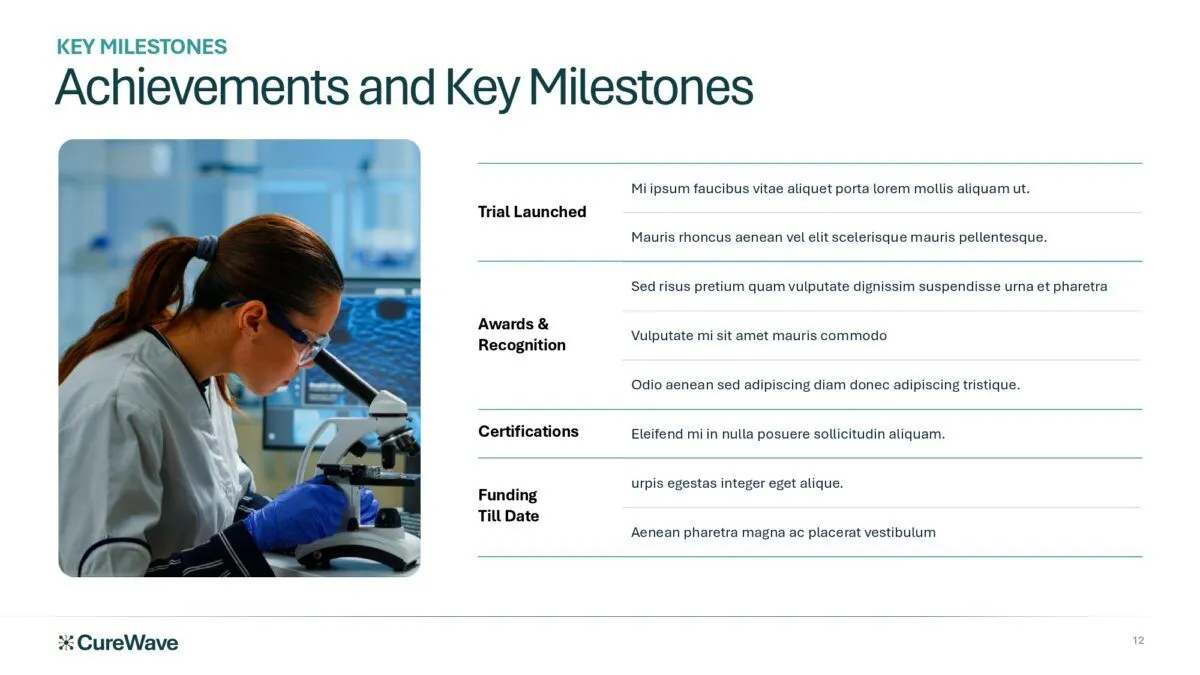
Key milestones
This slide provides a snapshot of your company’s journey and future goals
- Showcase major achievements and upcoming objectives
- Keep descriptions concise and results-focused
Financial projection
For many, particularly investors, the Financial Projection slide could be the most critical slide in your healthcare presentation
- Add key financial figures such as revenue, expenses, and funding
- Make sure to represent these figures visually with graphs or charts and highlight important parts of the graph/chart

Summing it up!
These 12 key presentation slides are your blueprint for crafting a presentation on healthcare that not only convey your message effectively but also leave a lasting impact on your audience at a healthcare conference.
Remember, the design of your slides should be minimal and professional, and the content needs to be concise and easy to understand. Use visuals like images, charts, graphs, and data visualization to enhance engagement.
And, if you’re still not sure where to start or need some help in designing a presentation for healthcare conference, we’re always here! Our multidisciplinary team has diverse creative capabilities and domain expertise, and we have experience working with healthcare companies and the VC and PE firms that back them.
Just contact us or book a discovery call, and let’s get started!
FAQs
1. What is the purpose of a healthcare conference presentation?
A healthcare conference presentation is meant to communicate complex clinical, scientific, or operational ideas clearly to a time-constrained audience. Unlike sales or investor decks, conference presentations focus on education, credibility, and relevance rather than persuasion, often balancing data with narrative clarity.
2. Which slides are most important in a healthcare conference presentation?
The most important slides usually include the problem or unmet need, clinical or scientific context, key data or evidence, practical implications, and a clear takeaway. The goal is to help the audience understand why the topic matters and how it applies to their work, without overwhelming them with excessive detail.
3. How much clinical or scientific detail should be included?
The level of detail depends on the audience. Clinicians and researchers may expect deeper data, while mixed audiences benefit from higher-level summaries supported by clear visuals. Strong healthcare presentations often separate core slides from backup slides so depth is available without slowing the main narrative, a structure commonly used in well-designed healthcare pitch decks
4. How should data and charts be presented at healthcare conferences?
Charts should highlight the key insight rather than display every data point. Clear labeling, simplified visuals, and consistent scales help the audience absorb information quickly. This approach is especially important when presenting clinical results or outcomes in large conference settings.
5. What makes a healthcare conference presentation visually effective?
Visual effectiveness comes from restraint and hierarchy. Slides should emphasize one idea at a time, use whitespace intentionally, and avoid unnecessary decoration. Reviewing real-world healthcare examples, such as those found in curated healthcare portfolio work, can help teams understand how complex content can still feel accessible.
6. Should healthcare conference slides be designed for reading or presenting?
Conference slides should primarily support live presenting. They are meant to complement what the speaker is saying rather than serve as a standalone document. If the slides will be shared afterward, a separate reading version is often more effective than trying to make one deck serve both purposes.
7. How early should teams start preparing conference presentation slides?
Healthcare conference slides should be prepared early enough to allow time for content review, data validation, and design refinement. Late-stage changes increase the risk of errors and reduce clarity. Many teams align conference presentations with broader communication standards, similar to those used in professional presentation design services
8. How can presenters ensure their message is remembered after the conference?
A clear narrative arc and a strong closing takeaway help reinforce key points. Summarizing implications for practice, research, or patient outcomes makes the presentation more memorable and increases the likelihood that the audience will revisit the material later.