

Table of contents

TL;DR
For Fund I presentation, the slides that matter most are those that clearly define mandate boundaries, separate realized performance from narrative, demonstrate sourcing defensibility, structure team credibility, and align returns with visible risk controls. This article breaks down the 7 slides institutional LPs actually underwrite illustrated through a real case study of ClearPath Capital Partners and explains how disciplined structure, not design embellishment, reduces friction in the IC process.
 ChatGPT
 Google AI
 Claude
 Perplexity
Institutional LPs are overloaded.
A typical pension, endowment, or family office reviews hundreds of fund opportunities annually. According to Preqin, more than 14,000 private capital funds are in market globally as of 2025, even mid-sized institutional allocators receive a steady pipeline of emerging fund decks each quarter. Analysts often have minutes to determine whether your materials advance to the next stage.
Most early-stage private equity fund presentations don’t fail because of strategy. They fail because they read like promotional materials instead of investment memos.
LPs don't invest in storytelling. They invest in underwriting clarity. The decks that earn diligence meetings are the ones that answer the right questions, in the right order, before the LP has to ask them.
ClearPath Capital Partners, an emerging lower-middle-market fund preparing for institutional expansion, came to M'idea Hub with a problem that reflects exactly this. The original fund deck had the substance but not the polish. It was dense, inconsistent, and lacked a clear LP narrative. Branding was minimal. Key investor questions, who you are, why now, and how you win, weren't sequenced tightly.
In this article, we break down the 7 slides that matter most in an institutional private equity fund deck, illustrated through a case study. If you're preparing to raise Fund I through Fund III, this will save you months of trial and error.
How Institutional Capital Actually Evaluates You?
Before we get into the slides, you need to understand the mental model your LP is using when they open your deck.
Institutional LPs are not evaluating you like a venture investor evaluating a startup. Your private equity fund presentation is filtered through an internal underwriting framework, typically translated into an investment committee (IC) memo prepared by an analyst or portfolio manager.
The analyst then extracts your strategy, dissects your track record, evaluates risk exposure, assesses alignment, and flags governance considerations. What you present visually becomes structured internally into categories such as:
- Strategy differentiation
- Market positioning
- Attribution and realized performance
- Sourcing defensibility
- Team institutionalization
- Downside protection
- Portfolio construction fit
If your deck forces the analyst to hunt for those answers, friction increases immediately.
This is where design becomes a more structural requirement.
A well-constructed private equity fund deck reduces cognitive effort. It anticipates the IC memo and sequences information accordingly. The investment thesis is clear in seconds. Performance is separated and attributed. Economics are transparent. Risk is visible, not buried.
Working on your fund deck right now? See how M'idea Hub designs institutional-grade fund presentations for emerging managers →
Case Context: ClearPath Capital Partners
Industry: Lower-middle-market private equity
Fund Stage: Emerging manager (institutional expansion phase)
Project Scope: Full private equity fund presentation redesign
Timeline: Compressed institutional fundraising window
The Challenge
ClearPath had credible deal experience and a differentiated sector focus. The underlying strategy was disciplined.
But the existing private equity fund deck slides were dense. Track record tables blended realized and unrealized performance. The investment thesis was spread across multiple pages.
Let's see how we trans
First, we ccreated a modern, flexible moodboard with institutional typography, a deep navy and steel color palette, and modular layouts for terms, team, and track record. Complex strategies and portfolio levers were redrawn into simple, scan-friendly visuals with consistent iconography.
Then we transformed all key slides into a sharper LP narrative. Complex terms, market data, and case studies were redesigned into clean infographics and concise storytelling , making the fund’s thesis and track record easy to digest.
The 7 Core Slide Blueprint of Private Equity Fund I Presentation
1. Cover Slide
Within seconds, institutional LPs register whether your private equity fund presentation reflects discipline, clarity, and composure. The first slide sets the underwriting tone for everything that follows.
What the ClearPath Cover Slide Gets Right
- Clean and restrained layout
- Strong visual hierarchy
- Focused image grid aligned with sector themes
- Sector focus without over-explanation

2. Market Opportunity
The market opportunity slide establishes whether your strategy sits within the market enough to support fund scale and focused enough to signal discipline. Institutional capital responds to defined opportunity, not expansive ambition.
What the ClearPath Market Slide Gets Right
- Three high-visibility data points highlighted in structured blocks
- Clean grid layout with consistent iconography
- Balanced white space and strong visual hierarchy

3. Investment Thesis & Strategy Overview
The investment thesis slide is where LPs determine whether your strategy is defined or generic.
In a private equity fund presentation, this slide must clearly articulate where in the value creation lifecycle you operate and why that positioning is defensible.
What the ClearPath Investment Thesis Slide Gets Right
- Clean lifecycle curve visualizing maturity over time
- Clear labeling of Venture, Growth, and Buyout stages
- Minimal text supporting the core visual
- Strong use of white space and directional flow

4. Track Record
For Fund I-III, track record is the single most scrutinized section of any private equity fund presentation.
It is the section LPs slow down on and the one most sensitive to structural clarity.
What the ClearPath Track Record Slide Gets Right
- Key performance metrics isolated visually
- Clean and structured deal table below
- Clear column hierarchy (Company, Sector, Exit Type, Acquirer, Year, MOIC)
- Consistent spacing and readable typography

5. Portfolio Case Study
Institutional LPs want to see how capital was deployed, how value was created, and how exit discipline was structured. This slide moves from abstract performance to tangible execution.
What the ClearPath Portfolio Case Study Slide Gets Right
- Clear headline with quantifiable outcome ($15M to $200M+ EV)
- Structured company overview bar across the top
- Clean investment snapshot table
- Visual Revenue & EBITDA progression chart
Every section has boundaries. Nothing overlaps.

6. Team
At the Fund I stage, the team IS the fund. Key person risk, succession planning, partner alignment, and institutional governance structures are all assessed through this slide. A team slide that reads like LinkedIn bios is a signal that the manager hasn't yet thought institutionally about talent and governance.
What the ClearPath Team Slide Gets Right
- Clear headline emphasizing operational and investment depth
- Collective experience framed at the top (150+ years)
- Uniform portrait layout with consistent framing
- Bullet points limited to relevant experience
- Clean spacing between profiles

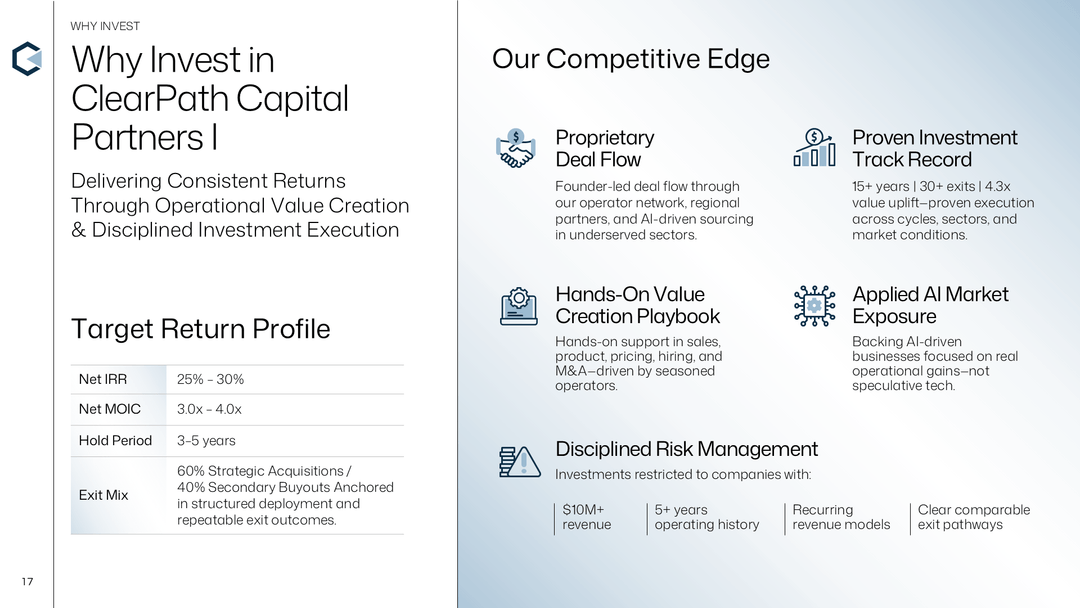
7. Why Invest
By the time an LP reaches this slide, they are not looking for new information. They are looking for coherence.
In a private equity fund presentation, the “Why Invest” slide must distill the strategy into a clear, defensible investment case.
For Fund I, this slide carries weight. It signals whether the fund is structured around repeatable advantages or assembled from loosely connected strengths.
What the ClearPath Why Invest Slide Gets Right
- Clear separation between return profile and competitive edge
- Visual consistency across icons and hierarchy
- Balanced layout - analytical on the left, strategic on the right
The slide is properly segmented. Each category stands on its own.
Key Takeaways
The LPs you're trying to reach have seen hundreds of decks this year. They've passed on managers with stronger track records than yours. They've passed on theses that were better articulated. Not because the strategy wasn't right, but because the presentation didn't give them what they needed to say yes.
Institutional capital moves slowly and deliberately. Every question your deck leaves unanswered becomes a reason to wait. Every slide that's unclear is a signal, about how you think, how you communicate, and how you'll operate as a long-term capital partner.
ClearPath came to us with a deck that had all the right ingredients and none of the right sequencing. In two weeks, we rebuilt it into a presentation that flows in the order LPs expect, from thesis to track record to team to terms, without a single wasted slide.
The substance was always there. The structure just needed to catch up.
If you're raising Fund I through Fund III and your deck isn't converting warm introductions into diligence meetings, the problem is almost certainly in how the story is being told — not in the story itself.
That's exactly what we fix. See the full ClearPath Capital Partners case study →
At M’idea Hub, we have designed and structured 100+ private equity fund decks, LP updates, annual meetings, deal memos, and portfolio strategy presentations for both emerging managers and established PE firms. Our experience working with top-tier private equity teams has shown a consistent pattern:
If you are preparing to raise fund and want your private equity fund presentation reviewed through an institutional lens, you can book a call to evaluate how your deck is structured — and where it may be creating friction. For established PE firms building non-emerging fund decks, our private equity pitch deck guide covers the 7 tips behind 50+ PE decks we've designed for institutional LPs.